
OTHER DESTINATIONS
CLICK & CHOOSE
Welkom
Hans Heerkens (1958-2025) wijdde een groot deel van zijn leven en aandacht aan de luchtvaart. Op deze website vindt u niet alleen eerder gepubliceerd materiaal over ruimtevaart en luchtvaart, maar ook zijn meest recente materiaal. Hans werkte aan de Universiteit Twente en was nooit verlegen om de media zijn mening te geven over wat er gebeurt in de luchtvaartindustrie.
Na 40 jaar o.a. editorials, analyses en artikelen te hebben gepubliceerd in diverse luchtvaartbladen was hij hier recent mee gestopt. Dit was altijd een manier voor hem om zijn gedachten en ideeën over de luchtvaart industrie met de wereld te delen. Daardoor ontstond het idee om een eigen website te lanceren waarop hij alle voor hem zo belangrijke stukken over de luchtvaart kon delen en kon bespreken. Helaas is de website niet geheel afgekomen en heeft hij deze nooit zelf ‘live’ gezien. Toch willen we deze website met daarop alle kennis en nalatenschap van Hans Heerkens graag met de wereld delen.
Totaal onverwacht heeft Hans zijn laatste vlucht genomen.
Met een zachte landing heeft hij zijn eindbestemming bereikt.
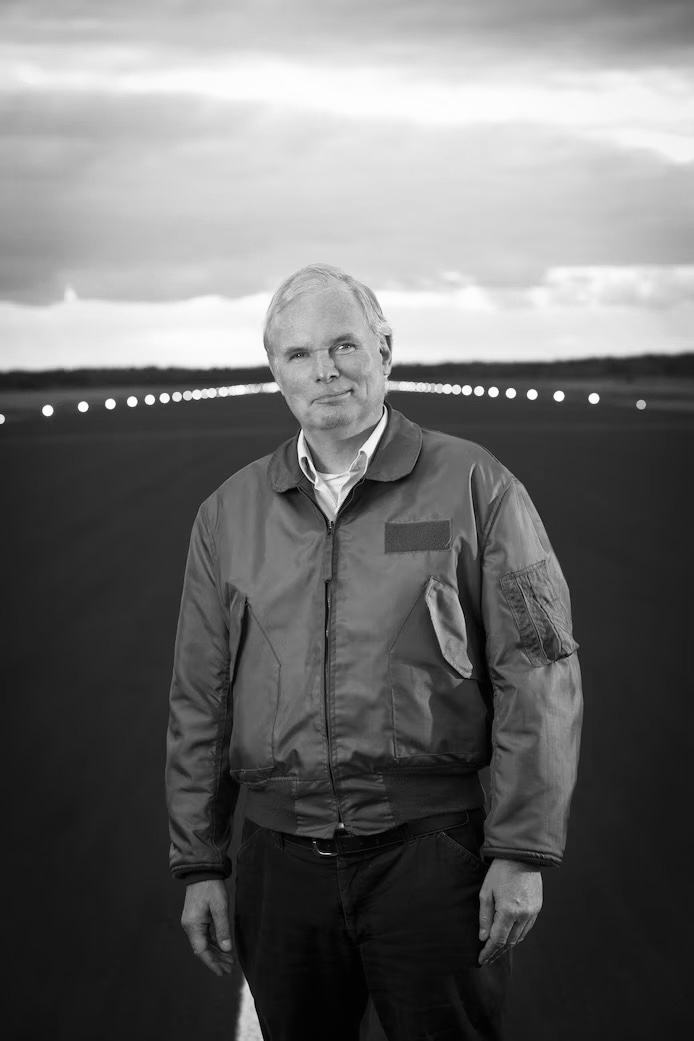
*Gouda, 16 september 1958
†Borne, 6 april 2025
Snippets
In this section of my website I will publish short (200-300 words) thoughts about the aviation/aerospace industry, Now that I have retired from writing a monthly analysis for the Dutch magazine ‘Piloot & Vliegtuig’ (‘Pilot & Airplane’ (of which you can find some of my articles on this website) I am at more liberty to write only about subjects that have my deep interest. These will be mainly, but not exclusively. about military aviation. There will not be a fixed frequency of my snippets; I will write something when I feel like it.
The prototype of the successor of the F-22 was revealed recently: the F-47. I had not heard of it before, and I cannot say sensible things about it. But perhaps you can, in a snippet. Let me know! Subjects of interest may be:
– Until now, the only photograph of the airplane shows the front. What could the rest of thew shape be? The cockpit seems very wide. This may indicate a two-person crew, but it may also make the cockpit more comfortable fur very long-duration missions. There is a frame in the middle of the windshield, which would be remarkable for a single-seat airplane.
– Similarities with some research airplanes (X-aircraft) were observed in the media. But these point to a ‘classic’ look at combat aircraft. What, for example, about optimization of vertical instead of horizontal maneuverability? In the ‘sixties, there was the notion of the Missileer, but in the end the F-14 Tomcat was developed. The Missileer had the looks and performance of a transport plane, but it carried a heavy armament of long-range missiles.
– Do the engine inlets give any indication of its maximum or cruise speed or cruising altitude?
– Will the close linkage with unmanned aircraft lead to non-conventional performance, shape or systems?
– What man-machine interfaces will be possible and needed to maximize the performance of the pilot?
– At what altitude do the engines deliver their maximum or cruise performance?
– What will likely be the doctrine for co-operation with unmanned systems?
Let us know your thoughts!
Canada and Portugal are considering not buying the F-35 Lightning II Joint Strike Fighter (JSF) because of unease with U.S. diplomacy. The discussion seems not to be focused on the aircraft’s merits. I do not want to go into this, except by saying that the F-35 is the latest series-produced combat aircraft to make its first flight (except the F-47). I would instead draw attention to the aircraft’s product support. Not particularly maintainance, but development. A few thousand F-35’s have been sold and the American armed forces have ordered hundreds of them – or more. This makes endeavors like the F-16’s Mid-life Update (MLU) program feasible. I do not expect that competitors like the Dassault Rafale and the Saab Gripen will have such elaborate programs, at least not so economically. The life-cycle costing method should make clear whether my concerns are appropriate. A senior official of the Royal Netherlands Air Force seems to have been impressed by the Rafale so it is not a foregone conclusion that the Rafale, although older than the F-35, is not an adequate aircraft.
The integration with unmanned combat aircraft – not merely as an add-on but as a true force multiplier, integrated in the overall air combat strategy – is a special issue of concern for me.
I think that political issues – which might have a national safety component – are a legitimate concern in combat aircraft acquisition. I have no definitive opinion as to which aircraft Canada and Portugal should buy, but development potential should certainly be one of the selection criteria.
The two prototype aircraft of the U.S, development program for unmanned combat aircraft have received official designations: YFQ-42 and YFQ-44, This implies that unmanned combat aircraft – for both air-to-ground and air-to-air applications – are now established in the U.S. Air Force, meaning a continuous development program, continued industrial involvement, doctrine development, integration of its use with other assets and establishment of a dedicated faction of personnel. Undoubtedly, other armed forces will follow this lead, meaning that the use of unmanned aircraft will evolve beyond reconnaissance and surveillance. It is not clear to me whether this is a positive development on a global level, but the trend is there.
It seems that the Dutch company VDL intends to license-produce the Swiss Destinus Rota jet-powered drone for the Dutch Ministry of Defense. This aircraft can reportedly reach a speed of 800 km/h which is on a par with jet trainers. If this is true, the use of high-performance drones is about to proliferate. If it is not true, high-performance combat drones will be introduced on a large scale in the coming years anyway.
Unmanned aircraft van be built lighter and cheaper, for they do not need life support systems for the crew. and some instrument interface. They are not dependent on crew scheduling. Unmanned passenger aircraft will become the norm. For military use. I wrote a proposal for an unmanned fighter that is available on request (I don’t want it to be too much in the open). For military aircraft, unpredictability may be an issue. Civil aircraft need to be – and possibly can – very predictable indeed.
Many forms of )public) transport become – or spawn – private transport later in their life cycle, sometimes with the intermediate development of social trends. Trains led to longer-distance transport and to demand for mobility, to cars for the privileged and eventually to cars for everyone. Passenger aircraft led to increased long-distance travel – and to the re-definition of ‘long-distance’. Air transport will, or can, become more individualized. Unmanned aircraft are the enabler. Autonomous unmanned aircraft can fly from anywhere to everywhere, be small (2-4 passengers), time saved by fewer stopovers and freedom in individual scheduling may lead to passengers being prepared to pay a premium. Passengers will not need, or be allowed, to operate the vehicles themselves, freeing time for reading, meetings etc. An infrastructure needs to be developed for channeling large numbers of small unmanned vehicles, more or less like the present road system, but in three dimensions, lessening traffic jams. At first these vehicles will mainly be used for professional or business purposes, enabling gradual introduction. But over time they will become more widespread, with the added benefit that people will become used to – and lose their fear of – travelling in unpiloted aircraft – better to be called autonomous aircraft.
A control, ATC and ground infrastructure should be in place, so the sooner a policy is developed for this, the better. The European Union, which is a combination of supranational policy and nationwide autonomy, can take this up as a unifying project and at the same time increase the cohesion and competitive power of its members.
What is the most important innovation of the past 200 years? Some would say: aviation. It democratized travel; the masses could visit places that were hitherto the domain of the elite. People could relate to members of other cultures, buy products made across the world and buy foreign newspapers at the local newsstand.
But for me, the most significant innovation is the telephone. Not only did it make regular contact between people in faraway places possible – the catchword here is ‘regular – but it was also an enabler for decentralized production and decision making. It gave rise to new means of communication such as fax, radio and email, and made people look beyond the borders of their village or reference group. It made air traffic control possible and co-ordination of flights practical. You could say that ocean liners and trains started his development, but aviation greatly enhanced the process.
I do not intend to belittle the importance of aviation. This is just to stimulate the thinking about the relevance of innovations – and of innovation.
The future of Fighters
New weapon systems may make old systems seem less important, but they will seldom completely replace them. Propfighters may seem extinct, but PC9’s and Hawks still carry heat-seeking missiles. Horses are still used in guerilla warfare. What will the successor of the F-22 look like? The aim of an F-22 is not to shoot down aircraft – it is to deny airspace to the adversary. A high-ranking US military man once said something like that it would be all right if something were found that would make enemy aircraft fall from the sky. I foresee low-orbit satellites disabling aircraft with laser beams. Of course you would need means to combat these satellites. Space invader is near! And you would still need close support aircraft and strategic bombers. Will we see a further diversification of aircraft? More multirole aircraft? A high-low mix like the F-5/F-16 combination of old? We’ll probably see a further cascading of aircraft with new high-end planes for demanding missions and simpler, perhaps older designs remaining in use as a ‘second tier’. Let’s not forget that the F-16 replaced many Phantoms. Was the F-16 a lower-tier Phantom or was the ‘poor man’s Phantom’, the F-5, replaced with a higher-tier aircraft?